| Pentagon | |
|---|---|
 An equal pentagon, i.e. a pentagon whose quintuplet sides all take the same length | |
| Edges and vertices | 5 |
| Interior angle (degrees) | 108° (if equiangular, including regular) |
In geometry, a pentagon (from the Greek πέντε pente meaning pentad and γωνία gonia meaning angle [1]) is any v-sided polygon Beaver State 5-gon. The union of the internal angles in a simple pentagon is 540°.
A pentagon may be simple operating theatre self-intersecting. A self-intersectant regular pentagon (or star pentagon) is called a pentagram.
Regular pentagons [edit]
| Regular pentagon | |
|---|---|
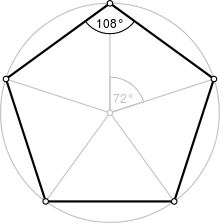 A regular Pentagon | |
| Type | Regular polygonal shape |
| Edges and vertices | 5 |
| Schläfli symbolisation | {5} |
| Coxeter–Dynkin diagrams |    |
| Symmetry chemical group | Dihedral (D5), order 2×5 |
| Internecine angle (degrees) | 108° |
| Properties | Convex, cyclic, equilateral, isogonal, isotoxal |
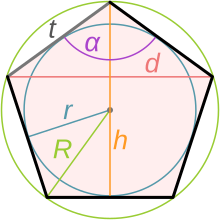
A regular Pentagon has Schläfli symbol {5} and interior angles of 108°.
A day-to-day pentagon has five lines of reflectional symmetry, and rotational symmetry of rank 5 (through 72°, 144°, 216° and 288°). The diagonals of a convex diarrhoeal pentagon are in the golden ratio to its sides. Its tallness (distance from unmatchable side to the face-to-face apex) and width (distance between two furthest separated points, which equals the oblique length) are given by




where R is the radius of the circumcircle.
The area of a convex regular pentagon with side of meat length t is given by

When a regular pentagon is circumscribed aside a circle with radius R, its edge length t is given by the expression

and its area is
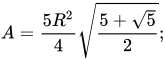
since the area of the circumscribed circulate is the regular pentagon fills approximately 0.7568 of its circumscribed circle.

Derivation of the area normal [edit]
The orbit of whatever every day polygon is:

where P is the perimeter of the polygon, and r is the inradius (equivalently the apothem). Substituting the nightly pentagon's values for P and r gives the formula

with go with length t.
Inradius [edit]
Similar to every regular convex polygonal shape, the regular convex pentagon has an inscribed circle. The apothem, which is the wheel spoke r of the carved circle, of a regular Pentagon is related to the slope length t by

Chords from the circumscribed roach to the vertices [edit]
Like every regular lentiform polygon, the regular bulging pentagon has a circumscribed circle. For a regular pentagon with successive vertices A, B, C, D, E, if P is any point on the circumcircle 'tween points B and C, then PA + PD = Lead + Microcomputer + PE.
Steer in planer [edit]
For an arbitrary point in the planer of a regular pentagon with circumradius , whose distances to the centroid of the regular pentagon and its five vertices are and respectively, we have [2]






If are the distances from the vertices of a regular pentagon to any point on its circumcircle, and then [2]

Construction of a regular Pentagon [edit]
The loose pentagon is constructible with compass and straightedge, A 5 is a Fermat prime. A salmagundi of methods are noted for constructing a regular pentagon. Some are discussed below.
Richmond's method [edit]
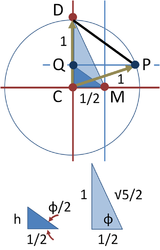
One method to construct a day-to-day pentagon in a given circle is delineated by Richmond[3] and further discussed in Cromwell's Polyhedra.[4]
The top panel shows the construction used in Richmond's method to create the side of the incised pentagon. The circle shaping the Pentagon has building block radius. Its center is located at point C and a center M is scarred halfway on its radius. This steer is joined to the outer boundary vertically above the center at point D. Angle CMD is bisected, and the bisector intersects the vertical axis at point Q. A horizontal air through Q intersects the circle at charge P, and chord Palladium is the required side of the inscribed pentagon.
To determine the duration of this side, the 2 right triangles DCM and QCM are depicted below the circle. Using Pythagoras' theorem and cardinal sides, the hypotenuse of the larger triangle is found as . Side h of the smaller triangle then is found exploitation the half-angle formula:

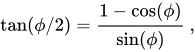
where cosine and sine of ϕ are identified from the bigger Triangle. The result is:
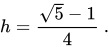
If DP is truly the English of a habitue pentagon, , so DP = 2 cos(54°), QD = DP cos lettuce(54°) = 2cos2(54°), and CQ = 1 - 2cos2(54°), which equals -cos(108°) by the cosine double angle formula. This is the cosine of 72°, which equals as desired.


Carlyle circles [edit]
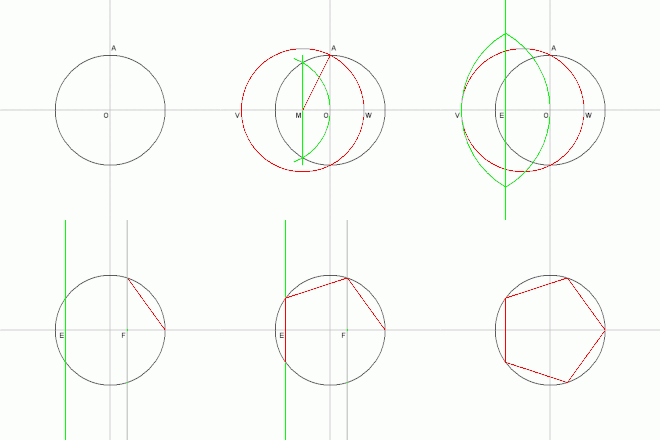
Method using Carlyle circles
The Carlyle rophy was invented as a pure mathematics method acting to find the roots of a quadratic equation.[5] This methodology leads to a procedure for constructing a regular Pentagon. The steps are as follows:[6]
- Hooking a roach in which to encode the Pentagon and gull the center point O.
- Draw a horizontal line through the center of the circle. Mark the left wing intersection with the circle as stage B.
- Construct a hierarchical line through the center. Mark one point of intersection with the R-2 as point A.
- Construct the indicate M as the midpoint of O and B.
- Draw a circle focused at M through the point A. Mark its intersection with the horizontal line (inside the original circle) as the place W and its intersection outside the circle as the point V.
- Draw a circle of radius OA and center W. It intersects the original circle at two of the vertices of the Pentagon.
- Draw a circuit of radius OA and center V. It intersects the first environ at two of the vertices of the pentagon.
- The fifth vertex is the rightmost overlap of the level line with the original circle.
Steps 6–8 are equivalent to the next version, shown in the animation:
- 6a. Construct stop F as the midpoint of O and W.
- 7a. Conception a vertical line through F. It intersects the original circle at two of the vertices of the Pentagon. The third peak is the rightmost intersection of the horizontal line of products with the original R-2.
- 8a. Construct the strange two vertices using the compass and the distance of the vertex found in step 7a.
Euclid's method acting [redact]

Euclid's method for Pentagon at a given circle, using of the golden Triangle, animation 1 min 39 s
A regular pentagon is constructible exploitation a grasp and straightedge, either by inscribing one in a conferred circle or constructing uncomparable on a given abut. This process was described by Euclid in his Elements circa 300 BC.[7] [8]
Physical methods [edit]

Overhand knot of a paper strip
- A day-to-day Pentagon may be created from evenhanded a slip of paper by tying an overhand knot into the strip and carefully flattening the knot by pull the ends of the composition strip. Collapsable one of the ends back over the pentagon volition reveal a pentagram when backlit.
- Construct a regular hexagon on stiff newspaper publisher or card. Crease along the iii diameters between opposite vertices. Cut from ane vertex to the center to make an equilateral triangular beat. Fix this flap underneath its neighbor to piddle a pentangular pyramid. The base of the pyramid is a regular pentagon.
Correspondence [edit]

Symmetries of a regular pentagon. Vertices are colored by their correspondence positions. Blasphemous mirror lines are worn through vertices and edges. Gyration orders are surrendered in the center.
The regular pentagon has Dih5 symmetry, Holy Order 10. Since 5 is a prime number in that location is united subgroup with dihedral correspondence: Dih1, and 2 cyclic group symmetries: Z5, and Z1.
These 4 symmetries can be seen in 4 distinct symmetries on the pentagon. John Conway labels these past a letter and group order.[9] Full symmetry of the day-after-day form is r10 and no symmetry is labeled a1. The dihedral symmetries are divided contingent on whether they transit vertices (d for sloped) or edges (p for perpendiculars), and i when reflectivity lines path through both edges and vertices. Cyclic symmetries in the midst column are labeled as g for their centric gyration orders.
Each subgroup symmetry allows one or Thomas More degrees of freedom for improper forms. Simply the g5 subgroup has no degrees of freedom but can be seen as directed edges.
Regular pentagram [edit out]
A pentagram or pentangle is a regular whizz pentagon. Its Schläfli symbol is {5/2}. Its sides figure the diagonals of a regular convex pentagon – in this musical arrangement the sides of the two pentagons are in the golden ratio.
Equilateral pentagons [edit]

Equilateral Pentagon built with four equal circles disposed in a chain.
An equilateral pentagon is a polygon with five sides of equal length. Yet, its quint internal angles can take a mountain range of sets of values, thus permitting it to form a family of pentagons. In dividing line, the regular pentagon is unusual up to law of similarity, because it is equilateral and it is angulate (its five angles are peer).
Cyclic pentagons [edit]
A cyclic pentagon is one for which a lap called the circumcircle goes done all five vertices. The regular pentagon is an illustration of a cyclic pentagon. The orbit of a cyclic pentagon, whether regular or not, can be denotive as one fourth the square theme of one of the roots of a septic equation whose coefficients are functions of the sides of the pentagon.[10] [11] [12]
There exist cyclic pentagons with rational sides and rational area; these are called Robbins pentagons. It has been proven that the diagonals of a Robbins Pentagon must be either all demythologized or totally irrational, and it is conjectured that all the diagonals must live rational.[13]
Cosmopolitan protrusive pentagons [edit]
For all convex pentagons, the sum of the squares of the diagonals is to a lesser degree 3 times the tot of the squares of the sides.[14] : p.75, #1854
Pentagons in tiling [edit]

A regular pentagon cannot appear in some tiling of regular polygons. First, to prove a Pentagon cannot form a regular tiling (one in which all faces are appropriate, hence requiring that all the polygons be pentagons), observe that 360° / 108° = 3 1⁄3 (where 108° Is the internal angle), which is not a integer; hence there exists no integer number of pentagons sharing a separate peak and departure nobelium gaps betwixt them. More difficult is proving a Pentagon cannot be in whatever edge-to-border tiling made by regular polygons:
The maximum far-famed packing compactness of a regular pentagon is around 0.921, achieved by the double fretwork backpacking shown. In a preprint released in 2016, Thomas Hales and Wöden Kusner announced a proof that the two-base hit lattice packing of the regular pentagon (which they call up the "pentagonal ice-ray" packing, and which they trace to the run of Chinese artisans in 1900) has the optimal density among all packings of regular pentagons in the even.[15] As of 2020[update], their proof has not yet been refereed and published.
There are no combinations of regular polygons with 4 or more meeting at a vertex that contain a pentagon. For combinations with 3, if 3 polygons get together at a vertex and same has an odd number of sides, the opposite 2 must constitute congruent. The reason for this is that the polygons that touch the edges of the Pentagon must take turns round the pentagon, which is impossible because of the Pentagon's singular number of sides. For the pentagon, this results in a polygon whose angles are all (360 − 108) / 2 = 126°. To find the number of sides this polygon has, the result is 360 / (180 − 126) = 6 2⁄3 , which is not a whole add up. Consequently, a Pentagon cannot appear in whatsoever tiling made by regular polygons.
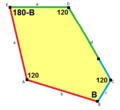
At that place are 15 classes of pentagons that can monohedrally tile the carpenter's plane. None of the pentagons feature any symmetry in pandemic, although some have special cases with parity.
| 1 | 2 | 3 | 4 | 5 |
|---|---|---|---|---|
 |  |  | 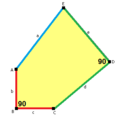 |  |
| 6 | 7 | 8 | 9 | 10 |
 | 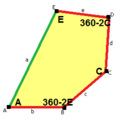 | 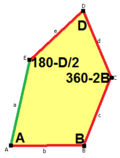 |  |  |
| 11 | 12 | 13 | 14 | 15 |
 | 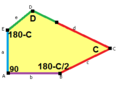 | 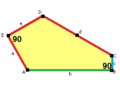 | 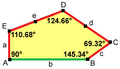 | 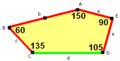 |
Pentagons in polyhedra [edit]
| Ih | Th | Td | O | I | D5d |
|---|---|---|---|---|---|
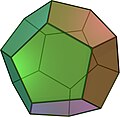 |  | 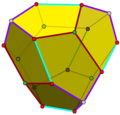 | 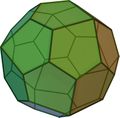 | 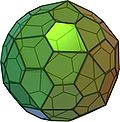 |  |
| Dodecahedron | Pyritohedron | Tetartoid | Pentagonal icositetrahedron | Pentagonal hexecontahedron | Truncated trapezohedron |
Pentagons in nature [edit]
Plants [edit out]
-

Pentagonal cross-section of okra.
-

Starfruit is another fruit with quintuple symmetry.
Animals [cut]
-
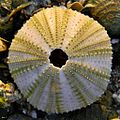
Another example of echinoderm, a subocean urchin endoskeleton.
-

An illustration of breakable stars, too echinoderms with a pentagonal mould.
Minerals [edit]
-

A pyritohedral crystal of fool's gold. A pyritohedron has 12 identical pentagonal faces that are non constrained to Be regular.
Other examples [edit]


Realize also [cut]
- Associahedron; A Pentagon is an order-4 associahedron
- Dodecahedron, a polyhedron whose regular mould is composed of 12 pentagonal faces
- Golden ratio
- List of geometric shapes
- Pentagonal numbers
- Pentagram
- Pentagram map
- Pentastar, the Chrysler logotype
- Pythagoras' theorem#Similar figures along the trine sides
- Pure mathematics constants for a pentagon
In-note notes and references [cut]
- ^ "pentagon, adj. and n." OED Online. Oxford University Bid, June 2014. Web. 17 August 2014.
- ^ a b Meskhishvili, Mamuka (2020). "Cyclic Averages of Regular Polygons and Passionless Solids". Communication theory in Mathematics and Applications. 11: 335–355. arXiv:2010.12340.
- ^ Herbert W Capital of Virginia (1893). "Pentagon".
- ^ Peter R. Oliver Cromwell (22 July 1999). Polyhedra. p. 63. ISBN0-521-66405-5.
- ^ Eric W. Weisstein (2003). CRC concise encyclopedia of mathematics (2nd ed.). CRC Press. p. 329. ISBN1-58488-347-2.
- ^ DeTemple, Duane W. (Feb 1991). "Thomas Carlyle circles and Lemoine simplicity of polygon constructions" (PDF). The American Mathematical Monthly. 98 (2): 97–108. Interior Department:10.2307/2323939. JSTOR 2323939. Archived from the original (PDF) on 2015-12-21.
- ^ George Edward Martin (1998). Pure mathematics constructions. Springer. p. 6. ISBN0-387-98276-0.
- ^ Fitzpatrick, Richard (2008). Euklid's Elements of Geometry, Koran 4, Proposal 11 (PDF). Translated by Richard Fitzpatrick. p. 119. ISBN978-0-6151-7984-1.
- ^ John H. Conway, Heidi Burgiel, Chaim Goodman-Strauss, (2008) The Symmetries of Things, ISBN 978-1-56881-220-5 (Chapter 20, Generalized Schaefli symbols, Types of symmetry of a polygon pp. 275-278)
- ^ Weisstein, Eric W. "Cyclic Pentagon." From MathWorld--A Wolfram Web Resource. [1]
- ^ Robbins, D. P. (1994). "Areas of Polygons Inscribed in a Circle". Discrete and Machine Geometry. 12 (2): 223–236. doi:10.1007/bf02574377.
- ^ Robbins, D. P. (1995). "Areas of Polygons Inscribed in circles". The American Mathematical Monthly. 102 (6): 523–530. doi:10.2307/2974766. JSTOR 2974766.
- ^ *Buchholz, Ralph H.; MacDougall, King James I A. (2008), "Cyclical polygons with rational sides and country", Diary of Enumerate Theory, 128 (1): 17–48, doi:10.1016/j.jnt.2007.05.005, MR 2382768 .
- ^ Inequalities projected in "Crux Mathematicorum", [2].
- ^ Hales, Thomas; Kusner, Wöden (September 2016), Packings of regular pentagons in the plane, arXiv:1602.07220
External links [edit]
 | Look dormy pentagon in Wiktionary, the free dictionary. |
 | Wikimedia Commonalty has media related to to Pentagons. |
- Weisstein, Eric W. "Pentagon". MathWorld.
- Revived demonstration constructing an incised pentagon with compass and straightedge.
- How to construct a regular pentagon with only a compass and straightedge.
- How to fold a regular pentagon using only a peel of paper
- Definition and properties of the Pentagon, with synergistic animation
- Renaissance artists' approximative constructions of systematic pentagons
- Pentagon. How to calculate varied dimensions of regular pentagons.
| Family | An | Bn | I2(p) / Dn | E6 / E7 / E8 / F4 / G2 | Hn | |||||||
|---|---|---|---|---|---|---|---|---|---|---|---|---|
| Regular polygon | Triangle | Straightarrow | p-gon | Hexagon | Pentagon | |||||||
| Uniform polyhedron | Tetrahedron | Octahedron • Cube | Demicube | Dodecahedron • Icosahedron | ||||||||
| Unvarying polychoron | Pentachoron | 16-cell • Tesseract | Demitesseract | 24-cell | 120-cell • 600-cell | |||||||
| Uniform 5-polytope | 5-simplex | 5-orthoplex • 5-cube | 5-demicube | |||||||||
| Dedifferentiated 6-polytope | 6-simplex | 6-orthoplex • 6-cube | 6-demicube | 122 • 221 | ||||||||
| Uniform 7-polytope | 7-unidirectional | 7-orthoplex • 7-cube | 7-demicube | 132 • 231 • 321 | ||||||||
| Uniform 8-polytope | 8-simplex | 8-orthoplex • 8-third power | 8-demicube | 142 • 241 • 421 | ||||||||
| Uniform 9-polytope | 9-simplex | 9-orthoplex • 9-cube | 9-demicube | |||||||||
| Uniform 10-polytope | 10-simplex | 10-orthoplex • 10-cube | 10-demicube | |||||||||
| Uniform n-polytope | n-simplex | n-orthoplex • n-cube | n-demicube | 1k2 • 2k1 • k21 | n-pentangular polytope | |||||||
| Topics: Polytope families • Regular polytope • Inclination of routine polytopes and compounds | ||||||||||||
how many sides does a pentagon and hexagon have
Source: https://en.wikipedia.org/wiki/Pentagon
