As these fossils advise, Antarctic continent hasn't always been as cold as information technology is now. Before Captain Scott and his team perished during their getting even journey from the South Pole in 1912, they had self-contained a number of distinguished fossils from near the Beardmore Glacier in the Transantarctic Mountains. When this collection was retrieved and analysed, information technology was found to hold in fossils of an ancient 'seed-fern' tree (Glossopteris). Not sole did this prove that the continent mustiness have been so much warmer in the past to support such vegetation, only the law of similarity with Glossopteris fossils found in South America, Confederate States of America Africa, and Commonwealth of Australi gave strong backing to the nascent idea, championed by Alfred Wegener, that the continents were once joined and have since emotional asunder – the theory of 'continental drift'.
During the 1960s, the mechanisms behind continental drift finally became understood and our red-brick theory of plate tectonics was born. As with other continents, sea trading floor spreading in some places and subduction in others has caused Antarctica's post to change over geologic time; and hence Antarctica hasn't always been located o'er the South Pole. Indeed in the upstage earth science agone, the pattern and configuration of morphology plates has been very different from now. For example, nigh 450 million age past the crust that makes up England was in the Southern Hemisphere while crust making up Antarctica straddled the equator!
About 200 million age agone, Antarctic continental crust was joined with South American, African, Indian, and Australian geographical region crust making up a large meridional land mass known as Gondwana (the southern part of the supercontinent titled Pangaea). After this time, Gondwana slowly split apart to produce Antarctica as a separate celibate, and Antarctica has gradually moved away from the other meridional continents towards its represent polar position.
Today the continent of Antarctica is part of the large Antarctic Plate which is one of the Earth's 7 stellar tectonic plates. The Antarctic Plate includes continental crust devising up Antarctica and its geographical area ledge, along with oceanic freshness beneath the seas surrounding Antarctica.
Glacial facts
Into the deep freeze…
Thus how and why did Antarctica enter the intense freeze? From the discussion to a higher place, you will know that the continent's gradual movement towards the Southwest Pole had something to do with it. However, this is not the whole story: a polar put away English hawthorn be necessary for a continent to accumulate an ice sheet; only this unequalled does not explain why the continent is so cold and the ice cover and so large. A full account requires consideration of past large-surmount changes that took space involving Earth's topography and atmosphere that helped to isolate the continent's climate and to reduce the sum of money of fondness transferred to Antarctic continent from the lower latitudes.
Before looking at the full range of causes, it is worth summarising Antarctica's tectonic history from when it was part of Gondwana onwards (million class = myr):
About 180 myr agone (in the early Geological period), rifting begins to split Gondwana apart sooner or later creating an extensive sea between Africa and Antarctic continent away 150 myr ago.
Africa and South United States begin to split apart about 130 myr ago (in the archeozoic Cretaceous period), with the Indian subcontinent breaking away from Antarctica and moving north about 125 myr ago.
From astir 100 myr agone (later Cretaceous) the crust of Australia and New Zealand begin separating from Antarctica. By this time Antarctica is already positioned over the Due south Pole.
By 40 myr agone (Tertiary multiplication) at that place is a open sea between Antarctica and Australia, and from about 35 myr long time ago the Palmer Peninsula divided from southern South America to open the Francis Drake Handing over.
As the continent moved towards its present position, its climate changed in response to the greater seasonal differences in sunshine and the overall bated level of solar input associated with high latitudes. However, even when its stead was roughly that of the present day, about 100 myr ago, information technology still had a more warmer climate than now. In that respect is fossil evidence for polar forests at various multiplication reaching as far as 85°S. Hence, Antarctic continent's position alone cannot explain its cold climate today.
Instead, we essential turn to big scale factors that altered the globose climate from the Cretaceous Period towards the present. Around 100 myr past the absorption of CO2 (and other greenhouse gases) was much higher than today, causing a warmer frown atmosphere across the integral major planet and preventing the build up of glacier ice anywhere. Additionally, the pattern of body politic and sea near Antarctica was such that warm currents could penetrate into high grey latitudes to moderate the polar mood.
Although concentrations of greenhouse gases are believed to have fluctuated during the Cretaceous and Third Periods, they have decreased towards the present, particularly after about 55 million years ago, coinciding with a long-full term round cooling trend. Two important tectonic events as wel explain the cooling of Antarctica: the widening of the sea between Antarctica and Australia and the cleave between South America and the Antarctic Peninsula. These changes in land/sea configuration were determinant for the establishment of the cold Seeable Current that circulates clockwise roughly the continent preventing warm water from reaching the slide.
Studies of rock formations on the continent and deposit deposits from the subocean floor indicate that Antarctic glaciers began to form in favourable locations during the late Eocene, perhaps as very much like 38 myr ago. However, even as late as 14 myr ago, fossils of tundra vegetation recently discovered from the McMurdo Plain Valleys show that the climate was similar thereto of the meridional tip of South U.S. at present. Shortly after this sentence, Antarctica cooled farther and the Eastern Antarctic Ice Sheet reached a sizing similar to today about 13.8 myr agone. The West Continent Ice Sheet reached its full Department of State about 6 myr ago. This is much earlier than in the Northern Hemisphere where glaciers did not develop into ice sheets until after 3 myr ago.
The precise reasons for the cooling of Antarctica and the timing of ice sheet formation are daedal and silent the subject of very much research. While tectonic processes and a decline in greenhouse gases played a office, there were also changes in the radiation pattern of atmospheric circulation and changes in the Earth's total zip Balance. Climatic factors are discussed in detail in Section 2, merely 2 key ideas from climate studies must be introduced here: the concepts of albedo and feedback processes.
Feedback mechanisms respond to changes in atmospheric, ocean and surface conditions all all over the world. Sometimes the feedback butt increase the effects of the cognitive operation (positive +), operating theatre restore conditions to their unconventional state (negative -).
Here is an example of a positive feedback loop:
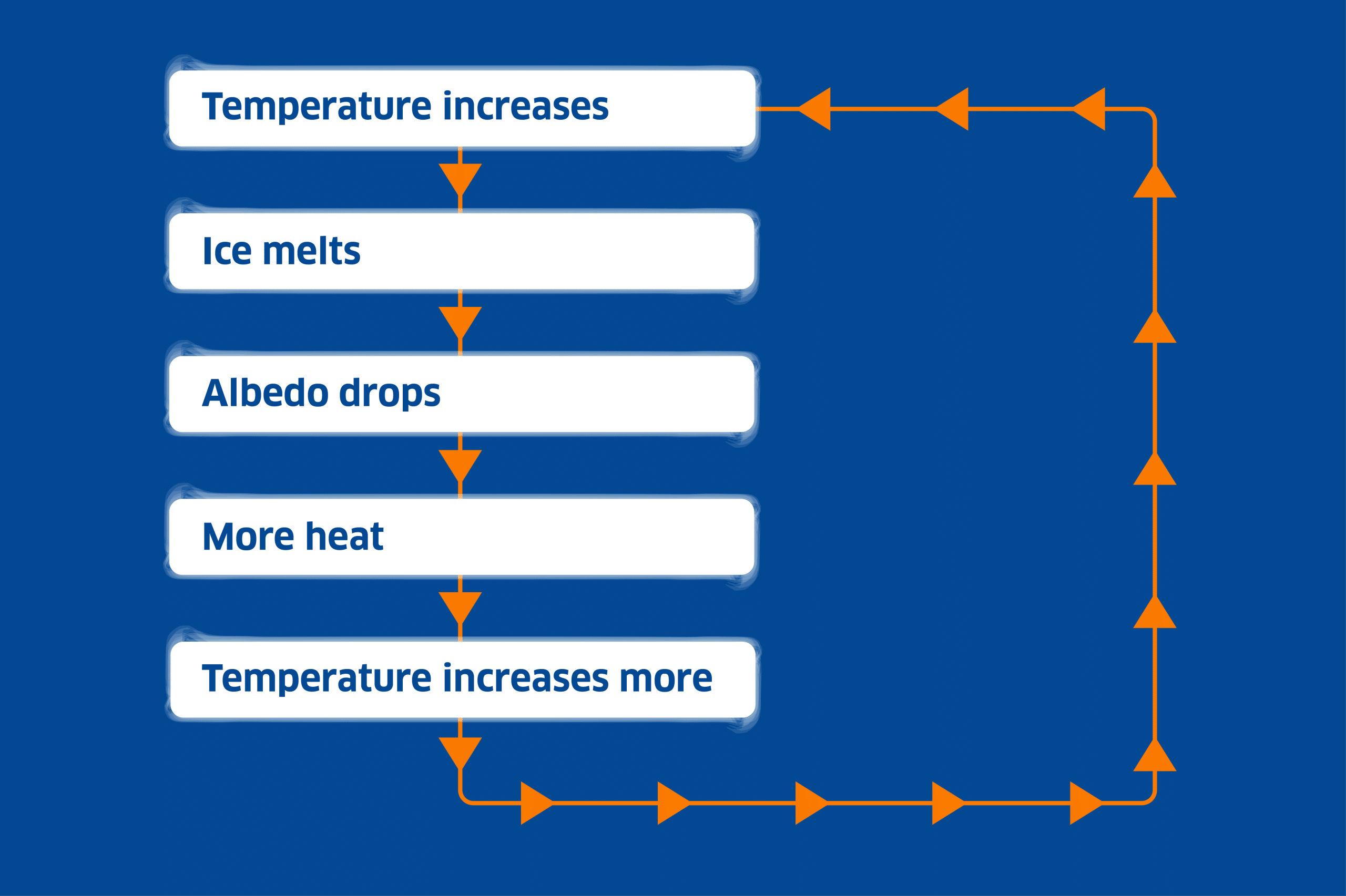
Once ice on Antarctica began to feast, the process reinforced itself through positive feedback mechanisms. With more than ice, in that location was more reflection of sun back to distance (a higher reflective power) and this acted to boost cool the surface temperature of the continent. Moreover, atomic number 3 the ice sheets grew, the surface became higher and therefore cooler. Quasi feedback mechanisms involving albedo and other climate factors were happening happening a more global scale as the Terra firma made its transition from heater conditions during the Mesozoic Era to tank conditions during the Geological era Era, culminating in the Ice Age of recent geologic time.
what type of plate boundary is the antarctic plate
Source: https://discoveringantarctica.org.uk/oceans-atmosphere-landscape/ice-land-and-sea/tectonic-history-into-the-deep-freeze/
